
Designing for Agency: Practical Frameworks to Navigate the Automation Abyss
This research-driven workshop moves beyond “should we allow AI?” debates to address a more fundamental question: How do we design learning that preserves human agency when AI can do the task faster?
Participants will engage with three actionable frameworks from the forthcoming book Beyond the Automation Abyss:
1. The Four Futures Matrix — Using scenario planning, participants map their institutions against two critical uncertainties (human agency × AI autonomy) to identify whether current practices lead toward Passive Consumption, Agentic Echo Chambers, Human-in-the-Loop, or Co-Learning futures.
2. Structural vs. Discursive Design — The critical insight: Policies tell students not to use AI (discursive); structural design makes authentic engagement inevitable. Participants will audit one assessment from their context, identifying where discursive rules fail and how structural redesign succeeds.
3. The Human Agency Scale (HAS) for Learning Design — A five-level framework (H1-H5) for intentionally calibrating human-AI collaboration in learning tasks. Participants leave with one redesigned assessment that embeds agency at the appropriate level.
This workshop synthesizes longitudinal student survey data, workforce research on automation potential, and case studies from universities restructuring assessment in response to generative AI. Attendees will leave with practical tools, not just theory—plus a diagnostic protocol for their own institutional context.
Key Takeaways:
- Understand why detection-based and policy-based approaches are structurally destined to fail
- Apply the Human Agency Scale to calibrate appropriate AI integration levels
- Redesign at least one learning task to embed human agency structurally
- Map institutional positioning on the Four Futures Matrix to inform strategic decisions
Facilitated By
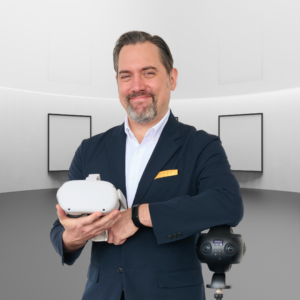
Eric Hawkinson
Learning Futurist, Kyoto University of Foreign Studies
Eric is a learning futurist, tinkering with and designing technologies that may better inform the future of teaching and learning. Eric’s projects have included augmented tourism rallies, AR community art exhibitions, mixed reality escape rooms, and other experiments in immersive technology.


